BMW X5 vs BMW 5 Series: Which Is Better for UK Family Driving?
Choosing between a BMW X5 and a BMW 5 Series comes down to how you use your car. Both offer premium interiors, strong performance and the comfort expected from a BMW, but they suit different types of family driving.
The BMW X5 is a large SUV with a raised driving position, substantial luggage capacity and available all-wheel drive. The BMW 5 Series is available as a saloon or Touring estate, offering a more traditional executive-car driving experience. For families who need generous boot space without moving to an SUV, the Touring deserves particular attention.
There is another consideration when buying either model second-hand: running costs. Fuel consumption, tyres, servicing, vehicle age and the condition of individual components can all influence the cost of ownership. An older or high-mileage premium car may also need repairs that are worth considering before you buy.
So, which is better for UK family driving? The X5 is worth considering if you value SUV practicality, a higher seating position and the ability to carry bulky items. The 5 Series Touring may be the more suitable choice if you want estate-car practicality with a lower driving position. The 5 Series Saloon is a sensible option for families who prioritise comfort and everyday road use over maximum luggage flexibility.
This guide compares the three options, explains the ownership factors to check and explores how an extended car warranty may fit into your plans.
1. BMW X5 vs BMW 5 Series: Understanding the Differences
Before comparing the cars, it is important to clarify the model names. The BMW X5 is an SUV, while the BMW 5 Series is available in different body styles, including the Saloon and Touring estate. These are not identical alternatives, so your comparison should reflect the type of 5 Series you intend to buy.
BMW X5: A practical premium SUV
The BMW X5 is designed for drivers who want a larger vehicle with a raised driving position and a flexible cabin. Depending on the model and specification, it can offer all-wheel drive, substantial towing capability and seating for up to seven people.
Its size can be useful for family holidays, carrying pushchairs, transporting sports equipment or travelling with several passengers. However, a larger SUV can be less convenient in narrow streets and tight multi-storey car parks. Tyre replacement, fuel use and some repairs may also cost more than expected.
The X5 is worth considering if your family regularly carries bulky luggage, prefers SUV access and benefits from the vehicle's available equipment.
BMW 5 Series Saloon: Comfort for everyday journeys
The BMW 5 Series Saloon is aimed at drivers who want executive-car comfort without the larger proportions of an SUV. It can suit school runs, commuting, motorway journeys and longer family trips.
Its conventional boot is useful for everyday luggage, but the opening and shape may make it less convenient than an estate for carrying particularly tall or awkward items. If you rarely need to transport large loads, that may not be a problem.
A saloon may be the better fit if you prioritise a lower driving position, refined road manners and a car that feels manageable for your usual journeys.
BMW 5 Series Touring: The estate-car alternative
The BMW 5 Series Touring is often the most relevant alternative to the X5 for families who need space. Its estate body provides a long load area and a large rear opening, making it easier to load suitcases, shopping, pushchairs and other everyday equipment.
It sits lower than the X5, which may appeal to drivers who prefer a traditional car rather than an SUV. The trade-off is that it does not provide the same raised seating position, and the exact ground clearance, drivetrain and equipment depend on the version.
If your main reason for considering an X5 is boot space rather than SUV styling or seating height, compare it directly with the 5 Series Touring before making a decision.
2. Boot Space and Family Practicality
Boot capacity is useful when comparing family cars, but the number alone does not tell the whole story. The shape of the load area, the boot opening, the rear seats and the space available with the seats folded all affect day-to-day usability.
BMW's published technical data gives the following figures for the specified generations.
| Model | Published luggage capacity | What it means for family use |
|---|---|---|
| BMW X5 G05 (non plug-in hybrid) | 650–1,870 litres | Generous luggage capacity for family holidays and bulky items; G05 plug-in hybrids have 500–1,720 litres instead |
| BMW 5 Series Touring G61 (2024 onwards) | 570–1,700 litres | Large estate boot with a practical load area |
| BMW 5 Series Saloon | Varies by generation and model | Suitable for everyday luggage, but less flexible for tall or bulky loads |
These are generation-specific examples, not a like-for-like comparison of every used X5 and 5 Series. G61 figures must not be applied to an older G31 Touring. Capacity can also change with powertrain and seating configuration. See BMW's X5 technical data and 5 Series Touring technical data for details.
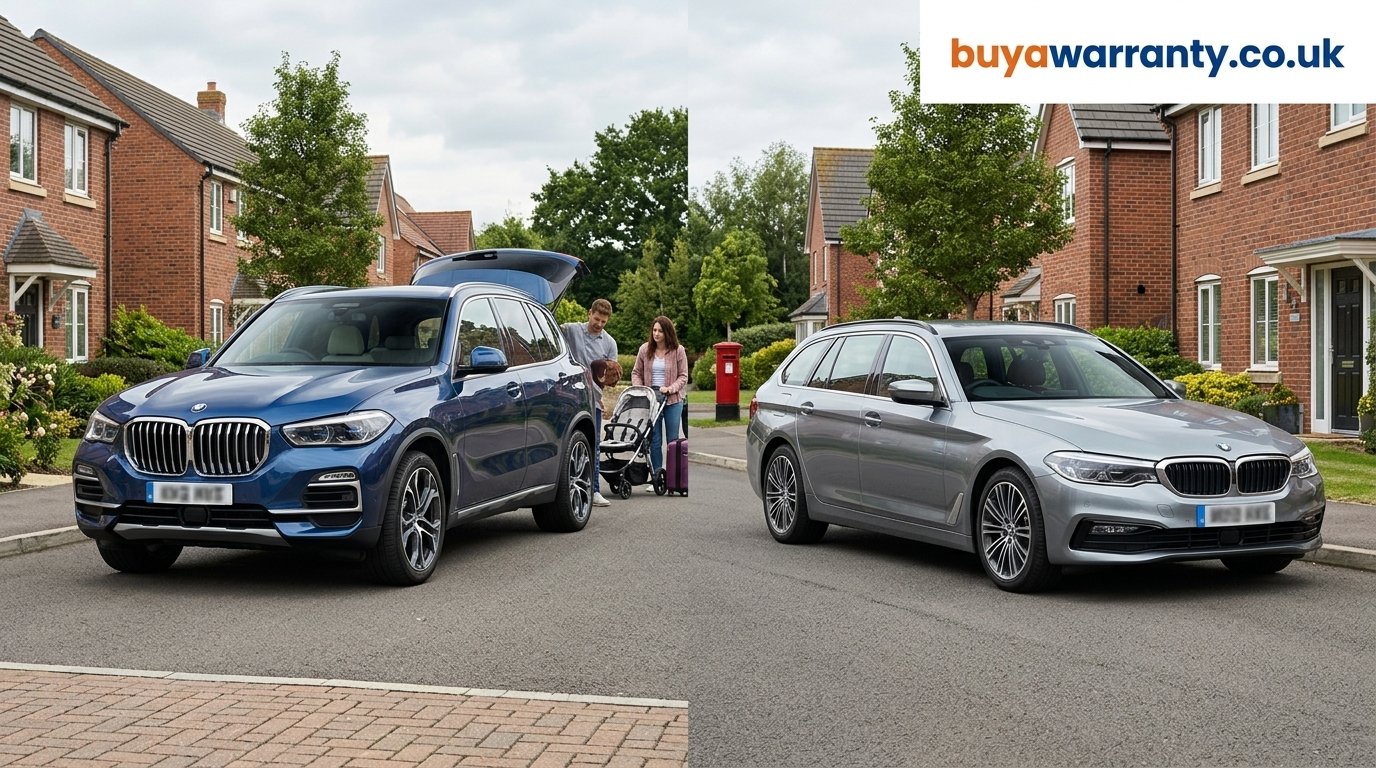
Which has the better boot?
The specified G05 BMW X5 has the greater published maximum luggage capacity of these two examples. That does not automatically make it the better family car for everyone.
An estate can be easier to load because of its long, relatively low load floor. An SUV may offer a more convenient seating height and a cabin layout that suits some families better. Consider how often you carry bulky luggage, whether you need to fold the rear seats and how easy it is to load heavy items.
What about child seats and family equipment?
If you regularly travel with children, inspect the exact car rather than relying on the model name alone.
Check the ISOFIX positions, rear-door opening, rear-seat access and the room available when a child seat is installed. Bring your pushchair or other bulky equipment to see whether it fits comfortably. If you need seven seats, verify that the specific X5 has the optional third row; not every version is configured this way.
For families with older children, passengers or pets, a test drive with the people and equipment you normally carry can be more useful than a specification sheet.
3. Fuel Economy and Everyday Running Costs
Fuel economy is one of the biggest factors to consider when comparing the BMW X5 with the BMW 5 Series. However, there is no single figure that applies to every version of either car.
A diesel model used mainly for longer motorway journeys may deliver a different result from a petrol model driven around town. Plug-in hybrids also need to be assessed differently because their fuel consumption depends heavily on charging frequency and how far they travel using electric power.
For a fair comparison, check the official figures for the precise engine, model year and drivetrain. WLTP figures are useful for comparing vehicles under a standardised test, but real-world consumption can differ.
What affects fuel consumption?
Several factors influence the cost of running either BMW:
- Engine and drivetrain: Engine size, power output and whether the vehicle uses rear-wheel or all-wheel drive can affect consumption.
- Journey type: Frequent short trips, congestion and cold starts can change fuel use compared with longer, steady journeys.
- Driving style: Speed, acceleration, tyre pressures and unnecessary weight can influence efficiency.
- Vehicle condition: Poor maintenance or an underlying mechanical issue may affect how a vehicle performs.
- Hybrid charging habits: A plug-in hybrid's results depend on how often it is charged and how it is driven.
Do not compare advertised MPG figures without context
If you are comparing an X5 diesel with a 5 Series petrol or plug-in hybrid, the headline figures may not provide a like-for-like comparison. Look at the same fuel type where possible, and consider your normal annual mileage and journey pattern.
For a used BMW Warranty car, also check its service history, MOT record, tyre condition and any warning lights. A vehicle with an attractive purchase price may not represent the best value if it needs immediate maintenance.
4. Common Used-Car Checks: BMW X5 vs BMW 5 Series
Both models are sophisticated vehicles with complex mechanical and electronic systems. That does not mean a particular fault is inevitable, or that every example will be expensive to maintain. Condition, maintenance, mileage and model specification make a significant difference.
The following are inspection points to discuss with a qualified technician, not a claim that every BMW X5 or 5 Series suffers from these issues.
BMW X5: Areas worth checking
1. xDrive and transfer-case operation
On an all-wheel-drive X5, ask the seller about any previous drivetrain repairs. During a test drive, pay attention to juddering, vibration, unusual noises or hesitation when manoeuvring and accelerating. These symptoms can have several causes, so a technician should diagnose them rather than assuming the transfer case is at fault.
2. Suspension and ride quality
Check whether the vehicle sits evenly, whether the ride is consistent and whether there are unusual knocks over bumps. If the specific vehicle has air suspension, ask about its condition and maintenance history. Do not assume every X5 has the same suspension equipment.
3. Engine, cooling and emissions systems
Look for coolant warnings, unexplained fluid loss, overheating, engine warning lights or irregular running. Diesel versions may have emissions-related systems that require attention, depending on the engine and usage pattern.
4. Service history and previous repairs
Confirm that servicing has been completed at appropriate intervals and ask for invoices for significant repairs. A digital service record is useful, but supporting paperwork can provide more detail about what was actually done.
BMW 5 Series: Areas worth checking
1. Gearbox behaviour
During a test drive, check that the transmission engages drive and reverse smoothly and changes gear without unexpected jolts, slipping or warning messages. Transmission behaviour varies by version, and symptoms should be assessed professionally.
2. Suspension, steering and tyres
Listen for knocks and feel for vibration or pulling while driving. Uneven tyre wear can point to alignment, suspension or tyre-pressure issues. Have any concerns inspected before purchase.
3. Engine and cooling system
Check for warning lights, fluid leaks, overheating and inconsistent engine performance. The relevant inspection points depend on whether the car has a petrol, diesel, plug-in hybrid or fully electric powertrain.
4. Electrical equipment and driver assistance
Test the air conditioning, infotainment, parking sensors, cameras, electric seats, windows and other fitted equipment. Electronic faults can be inconvenient and may require specialist diagnosis.
How much do BMW repairs cost in the UK?
Repair costs depend on the exact fault, model, parts required, labour rate and whether the repair is carried out by a BMW retailer or an independent specialist. A minor component repair and a complete assembly replacement can have very different costs, even when they relate to the same system.
Rather than relying on a single online estimate, ask for a written diagnosis and quote. Confirm whether the price includes parts, labour, VAT, diagnostic work and any related components that need replacing.
Before buying a used BMW, it is sensible to budget for routine servicing, tyres, brakes, MOT work and unexpected repairs. A warranty may help with eligible mechanical or electrical failures, but it should not be treated as a replacement for maintenance or a guarantee that every repair will be paid for.
5. Which BMW Is Better for Different Types of Family?
The best choice depends on the needs of your household rather than the badge or body style alone.
| Family need | Model worth considering | Why |
|---|---|---|
| Carrying bulky luggage regularly | BMW X5 | SUV layout and generous luggage capacity |
| Wanting estate practicality without an SUV | BMW 5 Series Touring | Long load area and large rear opening |
| Mostly commuting and everyday family journeys | BMW 5 Series Saloon | Executive-car layout suited to regular road use |
| Needing a raised seating position | BMW X5 | Higher SUV seating position |
| Managing tight parking spaces and narrow roads | Test both carefully | Overall dimensions, visibility and parking equipment matter |
| Buying second-hand on a set budget | Compare specific examples | Age, mileage, condition, history and repair needs matter more than the model name alone |
This is a starting point, not a universal ranking. A well-maintained example with a complete history may be a better purchase than a newer car with unclear maintenance records.
6. What to Check Before Buying a Used BMW
Before committing to either model, work through the following checklist.
Review the vehicle's history
- Check the service record and request invoices for major repairs.
- Review the MOT history for recurring advisories or failures.
- Confirm the mileage and look for inconsistencies in the available records.
- Check for outstanding finance, write-off history or other relevant vehicle-history concerns using appropriate UK checks.
- Confirm that the car's specification matches the seller's description.
Inspect and test-drive the car
- Start the engine from cold if possible and note any warning lights or unusual noises.
- Test the transmission, steering and brakes in safe driving conditions.
- Check the tyres for uneven wear and inspect the wheels for damage.
- Test the air conditioning, infotainment, cameras, sensors and other electrical equipment.
- Look for signs of leaks, accident repairs or poor-quality bodywork repairs.
- Arrange an independent inspection if you are unsure about the vehicle's condition.
Check the warranty position
BMW's UK new-car warranty is advertised as three years with unlimited mileage, subject to its terms and conditions. That is different from saying the car is covered for three years or 60,000 miles.
For a used BMW, confirm the first-registration date, any remaining manufacturer or approved-used cover, and whether any previous warranty has expired. Do not assume that every used vehicle has the same cover.
BMW explains its current warranty arrangements on its official UK warranty page. The precise terms applicable to a particular car should always be checked with BMW or the relevant warranty provider.
7. Could an Extended Car Warranty Be Worth Considering?
If you are buying a used BMW X5 or 5 Series, an extended car warranty is one option to consider when planning for unexpected repair costs. These vehicles contain complex mechanical, electrical and electronic systems, and the cost of a repair can depend on the exact fault and parts involved.
A warranty is not automatically the right choice for every driver. Its value depends on the policy price, what it covers, the exclusions, claim limits and the likelihood of needing an eligible repair. Compare the cost of cover with your budget and your ability to pay for repairs yourself.
What should you check in a BMW warranty policy?
Before purchasing cover, read the terms and confirm:
- Covered components: Check the policy's actual list of covered parts. Do not assume the engine, gearbox, turbocharger, transfer case, air suspension or electrical systems are included.
- Exclusions: Wear and tear, pre-existing faults, maintenance items and certain failure types may be excluded, depending on the policy.
- Claim limits: Check the maximum amount payable per claim and any overall limit.
- Eligibility: Confirm the vehicle's age, mileage, service history and condition meet the policy requirements.
- Repair approval: Understand whether authorisation is needed before work starts.
- Garage requirements: Check whether you can use your preferred repairer or must follow specific garage or labour-rate rules.
- Excess and contributions: Confirm whether you must pay an excess or contribute to the repair cost.
- Claims process: Find out what evidence is required and how claims are assessed.
Is a warranty better than keeping money aside for repairs?
There is no universal answer. Some drivers prefer to pay for repairs as they arise, while others value the predictability of paying for a defined level of cover. A warranty can reduce exposure to certain eligible repair bills, but it does not remove every financial risk associated with owning a used vehicle.
Compare policies carefully and make the decision based on the actual wording rather than a general promise that all major repairs will be covered.
Buy A Warranty: If you are considering cover for a used BMW, review the available plans and policy terms before deciding. The current quote journey offers claim limits of £1,000, £2,000 or £3,000 and labour-rate options of £50, £70, £100 or £150 per hour. These are selected cover options, not a promise that every repair will be paid in full. Terms & Conditions v3.7 require authorisation before repair work begins and invoices from a VAT-registered garage. Check the exact covered components, exclusions, vehicle eligibility and your selected excess before purchasing.
8. BMW X5 vs BMW 5 Series: Final Verdict
The BMW X5 and BMW 5 Series are designed for different priorities, so the better choice depends on your family's routine.
Choose the BMW X5 if you prefer an SUV, want a raised driving position and regularly need space for luggage or bulky equipment. Its size and equipment may be useful for family holidays, although you should account for fuel, tyres, servicing and potential repairs when setting your budget.
Choose the BMW 5 Series Touring if you want a spacious estate with a large boot but do not need an SUV's seating position. It is a particularly relevant alternative for families who value luggage flexibility and everyday usability.
Choose the BMW 5 Series Saloon if you mainly need a comfortable executive car for commuting, school runs and longer journeys, without regularly carrying large items.
Whichever model you choose, focus on the individual car's condition, service history, specification and ownership costs. If you are buying second-hand, arrange an appropriate inspection and understand any remaining manufacturer cover or extended warranty terms before making your decision.
A well-chosen car is not simply the one with the most space or the lowest advertised price. It is the one that suits your family, fits your budget and has a maintenance history you can trust.
FAQ’S
1. Is an extended warranty worth it for a used BMW X5 or 5 Series?
It can be worth considering if you want help managing the cost of eligible mechanical or electrical repairs after the original manufacturer warranty has ended. Whether it offers good value depends on your BMW's age, mileage, condition, the policy price and the cover provided.
Thinking about cover for your BMW? Review the available warranty options and compare the covered components, exclusions, claim limits and excess before choosing a plan.
2. What does a BMW extended car warranty cover?
Coverage depends on the specific policy. Some plans cover eligible failures involving listed mechanical and electrical components, while other parts, faults or circumstances may be excluded. Do not assume that components such as the gearbox, turbocharger, transfer case or air suspension are covered unless the policy explicitly says so.
Before you buy, check the policy wording to confirm which components are included, what exclusions apply and whether your vehicle meets the eligibility requirements.
3. Can I get a warranty for an older or high-mileage BMW?
Possibly, but eligibility depends on the warranty provider's requirements, including the vehicle's age, mileage, condition and service history. Buy A Warranty's Terms & Conditions v3.7 exclude vehicles over 15 years old or over 150,000 miles at the start of cover unless otherwise stated. Check the exact vehicle through the current quote journey; eligibility alone does not mean every fault is covered.
Check your vehicle's eligibility before requesting cover. Have its registration details, mileage and service history ready so you can establish which options may be available.
4. Can I choose my own garage for BMW warranty repairs?
That depends on the policy. For Buy A Warranty, Terms & Conditions v3.7 require prior authorisation before repairs begin and accept invoices only from VAT-registered garages. Check the selected labour-rate limit and repairer requirements before choosing your BMW specialist; the policy may not meet their entire hourly charge.
Want to use your preferred BMW specialist? Check the garage requirements and claims process before purchasing a policy, and always obtain the required authorisation before repairs begin.
5. Will a warranty cover an existing BMW fault or normal wear and tear?
Not necessarily. Existing faults, problems that began before cover started, routine maintenance and normal wear and tear may be excluded, depending on the policy. A warranty is generally intended to cover eligible failures under its terms, not to pay for every repair a used car needs.
If you have noticed a warning light, unusual noise or driving issue, get the vehicle assessed first. Read the exclusions carefully so you understand what the policy can and cannot cover.